


“I’m ambitious, strong and I get what I want” – Larisa Iordache @ The Medal Factory – Episode 5
The translation of the 5th episode of the TV show – The Medal Factory. If you want to watch the episode, you can download it from here.
THE MEDAL FACTORY (@Digisport)
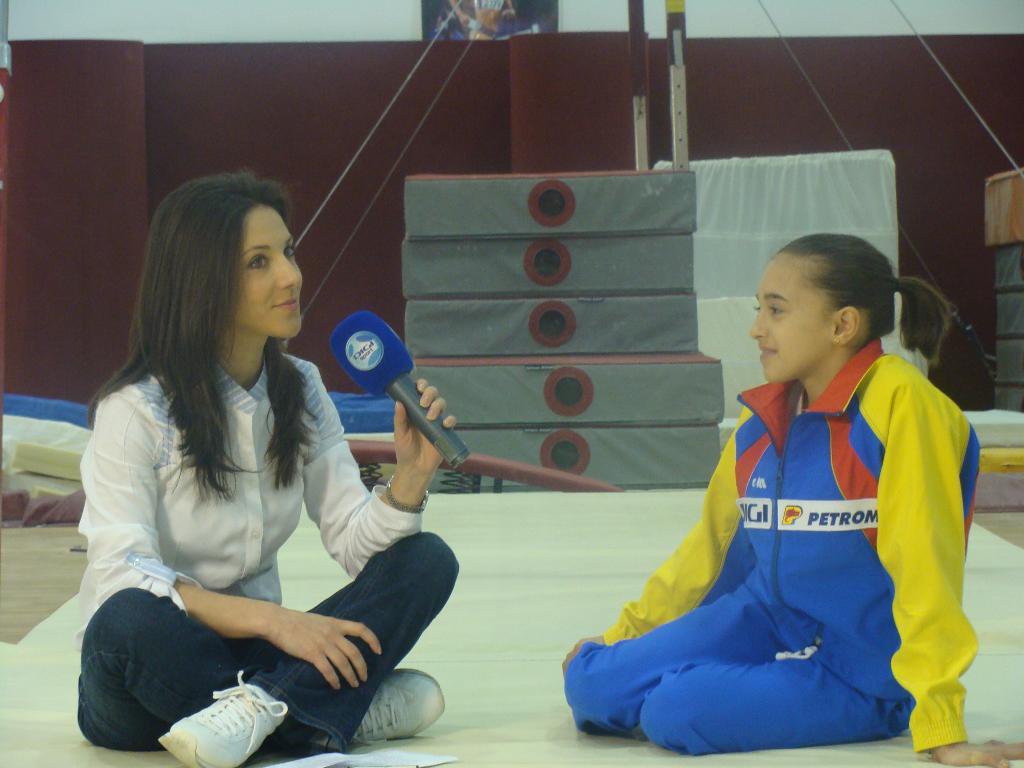
Andreea Raducan: I have here with me one of the youngest members of the team and at the same time, one of the biggest contenders for the most important competition for any sportsman, next year’s London Olympics. Larisa Andreea Iordache will be one of the members of the team representing us at this important competition.
Andreea Raducan: Welcome Larisa.
Larisa Iordache: Hello and thank you for all the support.
Larisa Iordache was born in Bucharest on the 19th of June, 1996. She comes from a family heavily involved with sports and this genetic heritage seems to have helped her become an important gymnast. Gymnastics has been the sport for her since she was 5 and a half, her desire was to evolve very fast and the results of her work are already visible.
Larisa Iordache: My mum took me to ballet, but one day while I was skating in the park with her and my brother, my coach, Mariana Silisteanu, spotted me and asked my mum If I was doing any sport or if she wanted me to. She told her about ballet and my now ex coach asked me if I wanted to try gymnastics. My mum refused but she took me there nonetheless. The first day I went there with my grandma, I didn´t want to go in. After two days, I asked her to take me again and I promised her I would try to go in. We went, I tried and I didn´t want to leave again. Now I wanted it, I didn´t need to be pushed into it.
Andreea Raducan: Do you have any brothers or sisters?
Larisa Iordache: Yes, I have a brother 5 years older than me who plays professional football.
Andreea Raducan: You are all sportsmen in your family….
Larisa Iordache: Yes. My mum played handball for 6 years but she had to give it up because her family couldn´t support her anymore. And my dad played football.
Andreea Raducan: How did you take in having been selected for the Junior National team and having to say goodbye to your family?
Larisa Iordache: It was not difficult; I knew why I was going there. I was surprised at having been selected, but it was easy. It took some time to adapt but then I got used to it.
Andreea Raducan: Who were your coaches back then?
Larisa Iordache: Mr and Mrs Nistor, Mr and Mrs. Moldovan, Ms. Carmen. I went to Deva wjth Mr. and Mrs. Moldovan and I worked with Gyuri Orban and Monica Nicu. Then they sent me to the Senior team.
Andreea Raducan: How much time did it take to be selected for the Senior team?
Larisa Iordache: 4 years, I was 10 when I left for the Junior team. I spent 3 years in Onesti and the 4th one in Deva. Last year I was very surprised and very happy to be told I had been selected for the Senior team.
Andreea Raducan: So it was a nice road for you, starting at Dinamo´s gym, then going to the Junior team in Onesti, then at Deva’s Juniors and then at destination, as we call the Olympic Center in Deva. I´m sure that once you left home, it was pretty difficult to spend your holidays again with you family. How different are these events inside the team?
Larisa Iordache: I don´t spend the holiday away from my family because I know they are wholeheartedly with me and at Izvorani I have the family we have created here. I enjoy it very much.
Andreea Raducan: How different are the kids from previous generations from the ones you work with today?
Raluca Bugner: There are big differences because today´s society is also different from the one 10 years ago. And this is normal; no one can stop evolution. 20 years ago a child did not have a mobile phone to communicate with his parents, you know this very well, he did not have TV in his room. Now our kids have everything, they can access information, entertainment; things that help them get through a difficult moment. Some time ago, they could not get any such help.
Octavian Bellu: There is a problem nowadays, they take monotony harder. If the girls from your generation could keep repeating elements during a larger period of time, could have high expectations from execution, for them this capability is lower. If it’s backed up by not being used to this, it can lead to less fortunate results. I believe they are slowly establishing their rhythm, they don´t want long breaks anymore; some were imposed by injuries but some were taken for less objective reasons. They will understand that they need to solve their consistency problem and then the results will start showing.
Today at The Medal Factory, Larisa proves that gymnastics is not a torture and it does not affect childhood. It´s a beautiful and complex sport which requires many working hours.
Andreea Raducan: Everybody says that gymnasts have a troubled childhood; I personally prefer the word “different”. How was your childhood?
Larisa Iordache: It was really different, full of surprises and emotions; it was not a troubled one. As a gymnast you get to see many countries, meet a lot of people and when you get where you want to be, you can become an example for others.
Andreea Raducan: What are the most beautiful countries you’ve seen so far?
Larisa Iordache: France is my favorite, I’ve been there a couple of times and I got to see it better.
Andreea Raducan: In the gymnastics world, we normally say that we like a country depending on the results of a competition. Is this also true for you?
Larisa Iordache: Yes, I’ve had results in France but it’s not only this. I’ve also had results in Belgium for example….
In order to be selected for the Junior National team, Larisa trained hard for a long time. She participated in many national and international competitions where results started showing up.
Larisa Iordache: I am a National Floor, Beam and All-Around Champion and after being selected for the team I also won Vault and Bars.
Andreea Raducan: What is the most important competition or trophy you have won so far?
Larisa Iordache: At last year’s Junior European Championships I won gold on floor, silver on beam and in the team competition and bronze in the All-Around.
Andreea Raducan: Like every gymnast, you also probably have the London Olympics as your goal. What are your expectations?
Larisa Iordache: I want to have a good 2011, to be able to train and compete, to get used to this new situation and for 2012, I´d like to do much more so that I can impress.
Adrian Stoica: Larisa is one of our top talents. A gymnast like her can make the difference.
Beam and floor were Larisa’s favorite apparatus. But she now believes that, to be a complete gymnast, you also need to have good results on bars and vault.
Larisa Iordache: I don’t have a favorite apparatus anymore, I used to like beam and floor and I still do. But I try to own all apparatus; this is what you need to win the Olympic medal.
Andreea Raducan: So you’d like to be a complete gymnast and win a medal in the All-Around. For this, you need all apparatus.
Larisa Iordache: Yes, I really want the gold medal in the All-Around at the Olympics.
Communicating with the staff is very important for Larisa Iordache. The relationship you establish with your coaches must be excellent if you want to achieve greatness.
Larisa Iordache: We must communicate because they are helping us; you have things to do and if you can’t do them, you must let them know so that they can give you a hand. This is very important.
Andreea Raducan: How does a day in your life at Izvorani look like?
Larisa Iordache: Work, rest, rehabilitation; we have here everything we need.
Andreea Raducan: Everyone says that gymnasts don’t have time for school. How do you study here?
Larisa Iordache: We do study, two hours a day before the morning training. You slowly get into the rhythm. It’s not true that gymnasts don’t study, but we only learn what we need to know.
Andreea Raducan: How do you motivate the girls on a bad day? How do you help them get over it?
Florin Cotutiu: You need to sense when a child is not well. This is normal, you can’t have only good days, there are times when they just can’t do what you ask them to. As a coach, you need to communicate; I’ve always asked the girls to do this, ever since I started to train. You can change the program, maybe go for something easier and the next day she will probably be able to go back to the initial one. I think this is much better, insisting might cause an injury. Communication between coach and gymnast is the most important thing.
Besides a world class staff, Larisa also benefits from having more experienced team mates around her, from whom she keeps learning.
Larisa Iordache: The fact that I have older girls close to me is very important; I can learn a lot from them. I get along really well with all of them, we are like family. We don’t fight, we don’t treat each other badly.
Andreea Raducan: I know you don’t have a lot of free time, but the one that you do have, how do you and the other girls spend it?
Larisa Iordache: We get some rest, we listen to music, we watch movies, it all depends on our mood, on what we need…
Andreea Raducan: Do you have any hobbies? Do you like animals, movies?
Larisa Iordache: Yes, I love dogs and I also like to shop.
Andreea Raducan: I know it’s too early to ask you this, but do you have any idea what you would like to do once you retire from gymnastics?
Larisa Iordache: I’d like to finish school, go to college and then I will decide what I want to do next.
Andreea Raducan: Would you like to become a trainer, for example?
Larisa Iordache: Yes, I’d like that. And why not, get to train elite.
Andreea Raducan: I know you have 2 trainings a day, how many hours do you train?
Larisa Iordache: 2 and a half – 3 hours per training, twice a day. If we want to go to the Olympics and win gold, we need to put in a lot of work.
Andreea Raducan: Did you ever want to give it all up? Either not wanting to keep training or competing or having an injury?
Larisa Iordache: There was a time but I fortunately got over it. It wasn’t because of this, I saw kids playing while I was training. I wanted to do that too but then I thought it was not worth leaving behind all the years I had put in. This is how I got over it.
Andreea Raducan: What motivates you? What makes you go back to the gym even if you have a bad time or less fortunate results?
Larisa Iordache: I’m thinking about the Olympics but at the same time I have to train….I mean I don’t have to, I want to train. I want to grow, I want to get where the other champions before me have been.
Andreea Raducan: Do you have any role model from the gymnasts you used to watch as a child?
Larisa Iordache: I liked Nadia ever since I was a little girl. After watching the 2004 and 2008 Olympics I realized I like this sport a lot, it’s beautiful and I want to do it too.
Larisa Iordache loves gymnastics. This sport pushes her to keep evolving. She is sometimes nervous in competition, but her self confidence is stronger.
Larisa Iordache: I’m ambitious, strong and I get what I want.
Andreea Raducan: How do you control your nerves before starting a beam or floor routine? You mentioned these as your favorite apparatus…
Larisa Iordache: I think I’ve already done this a thousand times in training, I need to be careful and focus only on what I have to do.
Andreea Raducan: What do you think about the other gymnasts in competition? Do you watch their routines?
Larisa Iordache: I watch the competition, but I am my only competitor. To be able to win that gold medal at the next competition, I need to perform well and then realize I’m the best.
Anca Grigoras: There is little I have to say about Larisa Iordache. Why? Because Larisa needs to fulfill two main conditions: maintain her love for gymnastics – she is terribly in love with gymnastics – and the most important thing, keep healthy. If these two conditions stay with her, we will see this little girl for many years to come, with great results. Competing with the very best gymnasts in the world…
Leave a Reply